Identity provider interoperability
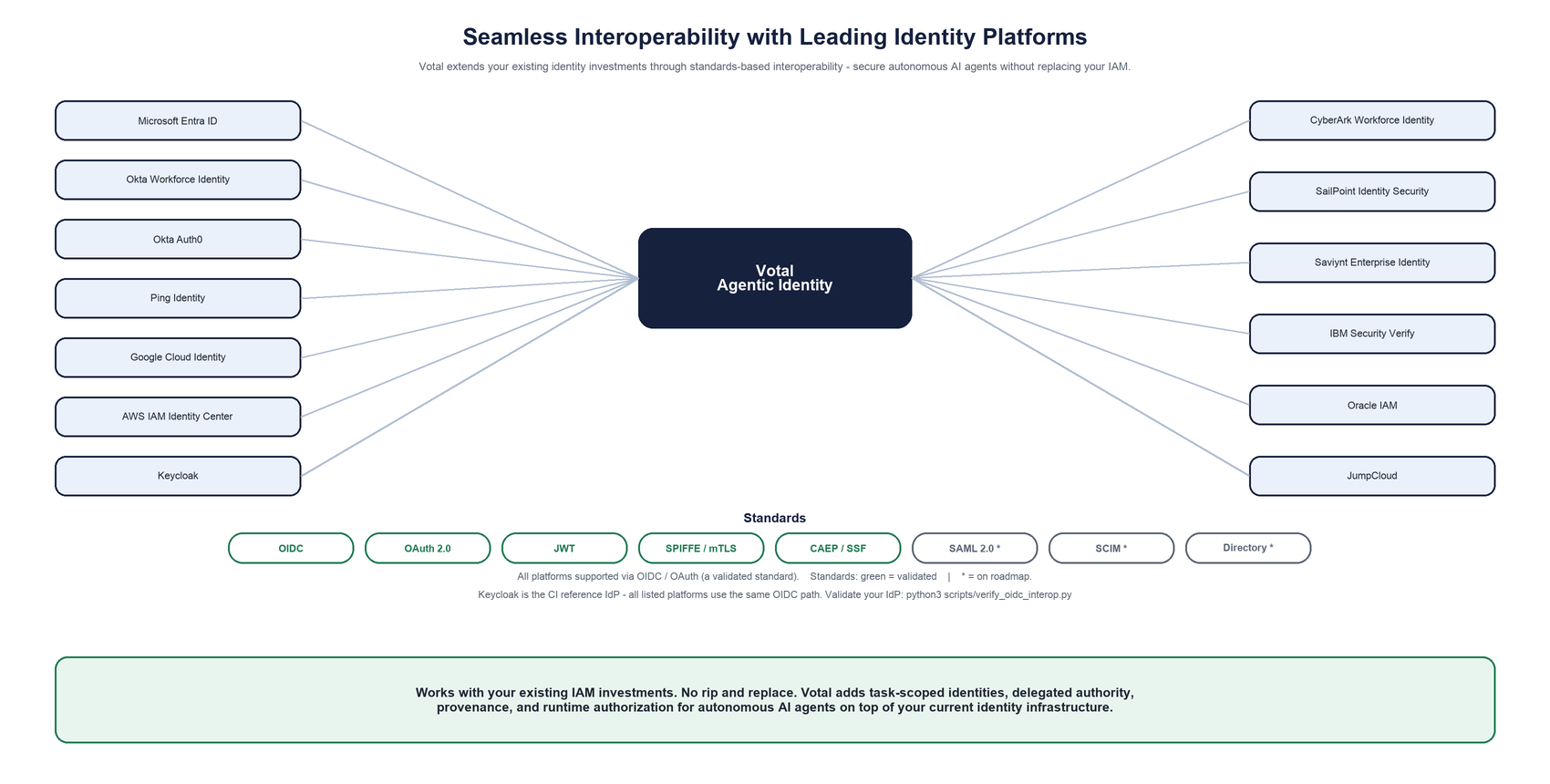
Shield secures autonomous AI agents on top of your existing identity infrastructure — it does not replace your IdP/IAM. Agents authenticate using the same standards (OIDC / OAuth 2.0) your IdP already speaks, and Shield then adds agent-specific controls (task-scoped capabilities, RBAC, provenance, and continuous identity / auto-revoke).
Table of contents
1. The model in one line
Keep your front desk. Your IdP (Okta, Microsoft Entra, Google, Ping, …) keeps issuing and checking identities. Shield trusts those identities over OIDC/OAuth and gives each agent one-time, least-privilege passes, logs every action, and can cancel an agent instantly — speaking the identity standards your IdP already uses. No rip and replace.
2. How to read our interop claims
We label maturity honestly so nothing gets over-claimed in a security review:
| Label | Meaning | Your action |
|---|---|---|
| Supported (OIDC/OAuth) | Works via the shared standard. Every listed IdP uses the same OIDC code path. | Confirm against your tenant with the verify command. |
| Supported (OIDC); SCIM roadmap | OIDC authentication works today; user/agent lifecycle provisioning (SCIM) is planned. | Use OIDC auth now; track SCIM on the roadmap. |
| Validated (standards table) | Tested end-to-end in CI. | Rely on it. |
| Roadmap | Not built yet. | Plan around it. |
“Supported (OIDC/OAuth)” is not a weaker claim than a per-vendor integration — it’s a stronger one: because interop is by the standard, every OIDC IdP works through one code path rather than a brittle one-off connector per vendor. Keycloak is our CI reference IdP (free, scriptable), so it’s the one wired into automated tests — but it exercises the identical path every other IdP uses.
3. Identity platforms
All platforms below interoperate via OIDC / OAuth 2.0.
| Identity platform | Interop via | Status |
|---|---|---|
| Keycloak | OIDC, OAuth 2.0 | Supported (OIDC/OAuth) — CI reference IdP |
| Microsoft Entra ID | OIDC, OAuth 2.0 | Supported (OIDC/OAuth) |
| Okta Workforce Identity | OIDC, OAuth 2.0 | Supported (OIDC/OAuth) |
| Okta Auth0 | OIDC, OAuth 2.0 | Supported (OIDC/OAuth) |
| Ping Identity | OIDC, OAuth 2.0 | Supported (OIDC/OAuth) — SAML on roadmap |
| Google Cloud Identity / Workspace | OIDC, OAuth 2.0 | Supported (OIDC/OAuth) |
| AWS IAM Identity Center | OIDC, OAuth 2.0 | Supported (OIDC/OAuth) — SAML on roadmap |
| Oracle IAM | OIDC, OAuth 2.0 | Supported (OIDC/OAuth) |
| IBM Security Verify | OIDC, OAuth 2.0 | Supported (OIDC/OAuth) |
| CyberArk Workforce Identity | OIDC (auth) | Supported (OIDC); SCIM roadmap |
| SailPoint Identity Security | OIDC (auth) | Supported (OIDC); SCIM roadmap |
| Saviynt Enterprise Identity | OIDC (auth) | Supported (OIDC); SCIM roadmap |
Discovery + JWKS reachability has been verified live against Google and
Microsoft Entra. Any IdP that publishes a standard
/.well-known/openid-configuration works the same way.
4. Standards
| Standard | Status | Notes |
|---|---|---|
| OIDC | Validated | id_token validation against the IdP JWKS; provider registration |
| OAuth 2.0 | Validated | Token exchange (RFC 8693), dynamic client registration |
| JWT / JWS / EdDSA | Validated | Signed, build-bound agent identity + capability tokens |
| SPIFFE / WIMSE + mTLS | Validated | Workload identity for agents |
| CAEP / SSF | Validated | Continuous signals — emit on revoke, consume to revoke (details) |
| SAML 2.0 | Roadmap | Planned |
| SCIM | Roadmap | User/agent provisioning + lifecycle; planned |
| Enterprise directory integration | Via standards | Through OIDC / OAuth claims |
5. Prove it against your own IdP
scripts/verify_oidc_interop.py runs Shield’s own OIDC validator
(core/oauth/oidc_client) against any IdP: it fetches the OpenID discovery
document, resolves and fetches the JWKS, and (optionally) validates a real
id_token — signature, issuer, audience, expiry. This is what turns
“Supported” into “validated for my IdP.”
# discovery + JWKS reachability (no login required) — works for any public IdP
python3 scripts/verify_oidc_interop.py --issuer https://accounts.google.com

# full end-to-end validation of a real login token (gold-standard proof)
python3 scripts/verify_oidc_interop.py \
  --issuer https://<tenant>.okta.com \
  --audience <client_id> --id-token "<paste id_token>"
It prints PASS/FAIL per check plus a copy-paste evidence line, and exits
non-zero on any failure (so it drops straight into CI).
Run it from the repo root so
core/is importable. Verified live against Google (RS256, multiple keys) and Microsoft Entra; Keycloak is validated end-to-end viasetup_keycloak.py+test_local_oidc.py.
6. What Shield adds on top of your IAM
| Capability | Plain English |
|---|---|
| Task-scoped identities | Single-use, short-TTL capability tokens scoped to one tool + resource — a one-time key for one door, not a master key. |
| Delegated authority | An agent can hand a helper agent a narrower pass, never a wider one. |
| Provenance | Tamper-evident audit lineage from prompt to tool execution. |
| Runtime authorization | RBAC + per-action capability verification at the tool boundary. |
| Continuous identity | CAEP/SSF auto-revoke: a detection — or an EDR/IdP signal — revokes the agent in real time. |
See also
- Continuous Identity & Auto-Revoke — closed-loop revoke and CAEP/SSF signal exchange with your IdP/EDR.
- Agentic Integration Guide — mint agent identity tokens and capability tokens.
- Guard an External Agent — put Shield in front of a hosted agent over a proxy.