Continuous identity, auto-revoke & CAEP/SSF
Move agent identity from point-in-time mint + verify to a live, posture-aware
loop: when something is detected, Shield revokes the agent before more damage is
done, and it exchanges those decisions with your IdP/EDR over open standards.
Table of contents
1. Closed-loop auto-revoke
Normally a guardrail blocks a single request and the kill switch is a manual action. Auto-revoke closes the loop: when a high-signal guardrail fires on a request that carries a verified agent identity, Shield automatically revokes that agent instance — which kills both its agent token and all of its outstanding capability tokens — so the next action cannot execute.
How it works
- A trigger guardrail (default:
adversarial_detection,system_prompt_leak) blocks a request that carries a verified agent identity (X-Agent-Token). - Shield calls
revoke_instance(agent_instance_id). - Because both
verify_agent_tokenandverify_caphonour instance revocation, the agent’s token and every cap it already minted stop verifying. - An
auto_revoketelemetry event is recorded and a CAEPsession-revokedsignal is emitted (see section 2).
Burns the caps, not just the token. A single revoke invalidates the instance’s outstanding capability tokens — previously, revoking an instance stopped its token but not caps it had already minted.
Safety
- Off by default. Enable with
SHIELD_ENABLE_AUTO_REVOKE=true. - Fires only when a verified agent identity is present, so plain tenant-key chat traffic is never affected.
- Fully defensive: a failure in the revoke path never breaks the request being served.
Configuration
| Variable | Default | Meaning |
|---|---|---|
SHIELD_ENABLE_AUTO_REVOKE |
(off) | Master switch (true/1/yes). |
SHIELD_AUTO_REVOKE_GUARDRAILS |
adversarial_detection,system_prompt_leak |
Comma list of guardrails that trigger a revoke. |
SHIELD_AUTO_REVOKE_TTL_SECONDS |
3600 |
Revocation TTL. |
After a revoke, the agent must obtain a fresh identity token to act again — a new token is unaffected (only the revoked instance id is blocked for the TTL).
Manual revoke — tenant self-service
A tenant can revoke its own misbehaving agent with only its API key — no platform admin key:
curl -X POST "$SHIELD/v1/tenant/me/agent-auth/revoke" \
  -H "X-API-Key: <tenant-key>" -H "Content-Type: application/json" \
  -d '{"agent_instance_id": "<instance-id>", "reason": "investigating"}'
The instance is matched against the tenant that minted it, so a tenant can only
revoke instances it owns (revoking another tenant’s instance returns 403/404).
The admin endpoint POST /v1/shield/auth/revoke remains for platform operators
(cross-tenant, by agent_instance_id / user_sub / jti).
2. CAEP / SSF — continuous signals
Auto-revoke is internal to Shield. Real environments also learn about risk from the IdP (session killed), the EDR (device non-compliant), or the SIEM. Shield speaks the OpenID Shared Signals Framework (SSF) and the Continuous Access Evaluation Protocol (CAEP) so risk flows both ways.
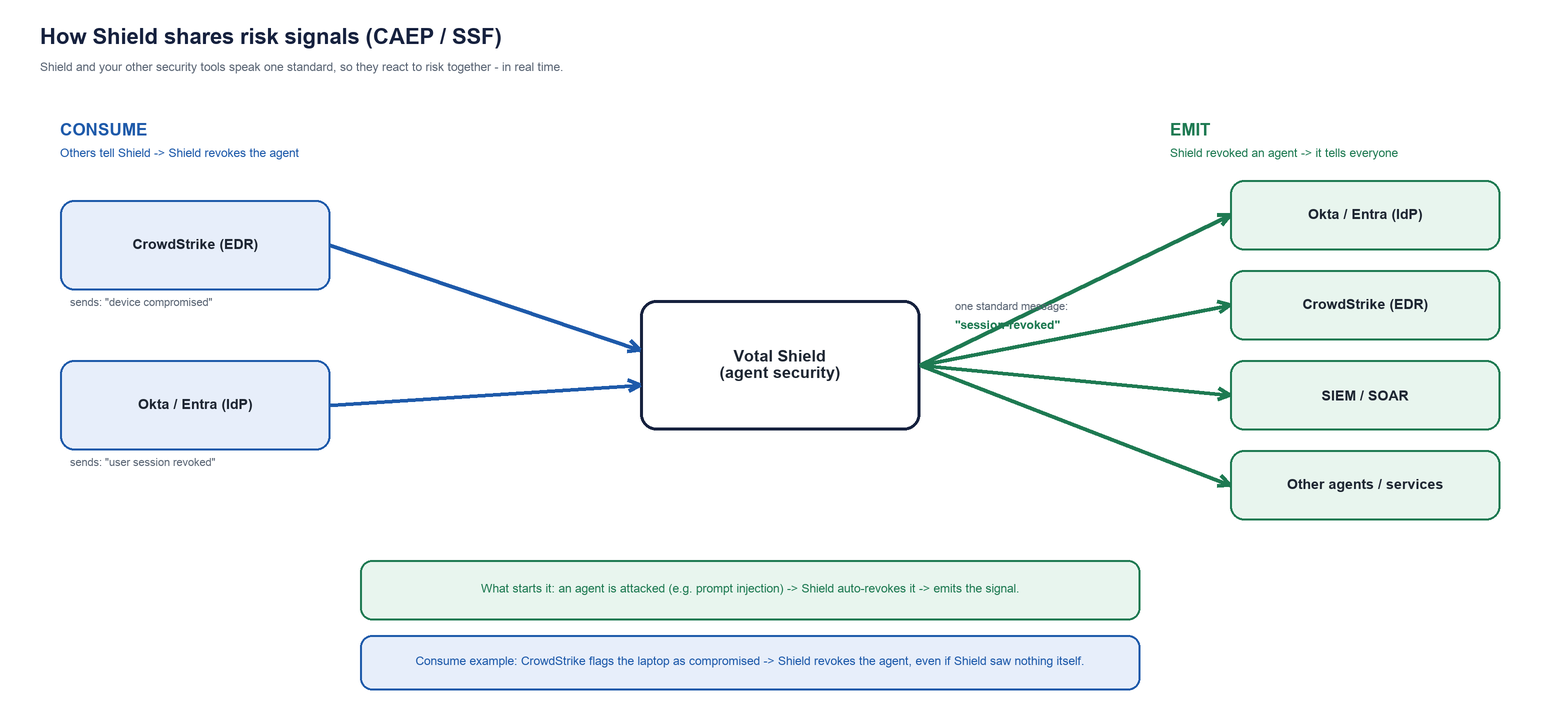
In plain terms: emit = Shield tells your other tools when it revokes an agent (they drop it too); consume = your tools tell Shield when they see risk (a compromised device, a killed user session) and Shield revokes the agent — even if Shield itself saw nothing. Everyone reacts to the same alarm, in real time.
- Emit — on a revoke, Shield builds a signed CAEP
session-revokedSecurity Event Token (SET, RFC 8417) and pushes it to a configured receiver, so the rest of your stack drops the agent too. - Consume — Shield accepts pushed SETs and revokes the matching agent instance or user.
Receive events (consume)
POST /v1/shield/ssf/events accepts a SET. A session-revoked,
credential-change, or non-compliant device-compliance-change event revokes
the subject (agent instance or user) in Shield. So an EDR marking a device
non-compliant, or an IdP killing a user session, instantly revokes the agent —
without Shield building any endpoint telemetry itself.
# Closed by default. Enable by setting a receiver token, then present it:
curl -s -X POST "$DP/v1/shield/ssf/events" \
  -H "Authorization: Bearer $SHIELD_SSF_RECEIVER_TOKEN" \
  -H "Content-Type: application/secevent+jwt" \
  -d '{"iss":"https://your-idp","jti":"1","iat":1,
       "events":{"https://schemas.openid.net/secevent/caep/event-type/session-revoked":
                 {"subject":{"format":"opaque","agent_instance_id":"inst-123"}}}}'
# -> 202 {"status":"accepted","applied":[{"event":"session-revoked","type":"instance","id":"inst-123"}]}
Security: the receiver is closed by default. It can revoke access, so it only acts when
SHIELD_SSF_RECEIVER_TOKENis set and presented as a bearer token (constant-time compared). If unset, the endpoint returns503. An optionalSHIELD_SSF_TRUSTED_ISSUERSallowlist restricts which transmitters are honoured. (Production deployments should additionally verify the SET signature against the transmitter’s JWKS.)
Discovery
GET /v1/shield/ssf/.well-known/ssf-configuration returns the transmitter
metadata (issuer, supported events, delivery method) for receivers that
auto-discover.
Configuration
| Variable | Used for | Meaning |
|---|---|---|
SHIELD_SSF_ISSUER |
emit | Transmitter iss (default https://votal-shield). |
SHIELD_SSF_AUDIENCE |
emit | SET aud (default ssf-receivers). |
SHIELD_SSF_PUSH_URL |
emit | Receiver endpoint to POST emitted SETs to. |
SHIELD_SSF_PUSH_TOKEN |
emit | Bearer token for the push (optional). |
SHIELD_SSF_PRIVATE_KEY |
emit | Hex Ed25519 key to sign SETs (else ephemeral). |
SHIELD_SSF_RECEIVER_TOKEN |
consume | Required to enable the receiver; the bearer callers must present. |
SHIELD_SSF_TRUSTED_ISSUERS |
consume | Optional comma list of allowed transmitter iss. |
Supported CAEP event types: session-revoked, credential-change,
device-compliance-change, assurance-level-change.
3. Auth telemetry
Auth decisions are counted per tenant and exposed at
GET /v1/tenant/me/agent-auth/stats. Relevant counters:
| Event | When |
|---|---|
token_issued / token_rejected |
agent token minted / failed verification |
cap_minted / cap_verified |
capability minted / verified |
cap_replay / cap_invalid |
replayed nonce / bad signature, expiry, or instance revoked |
revoke |
manual or SSF-driven revoke |
auto_revoke |
closed-loop auto-revoke fired |
Where this fits
This is the runtime response layer of the Votal platform: detect (guardrails), decide (RBAC + capabilities), and now respond (auto-revoke) and interoperate (CAEP/SSF). It pairs with the Developer Guide — MCP & APIs (how agents get governed tool access), the Identity Provider Interoperability guide (how Shield trusts identities from your existing IdP over OIDC/OAuth), and the Security & Compliance evaluation.